We now have the first signals from our AI Work Readiness Pulse, the self-assessment we launched in May to explore where AI is putting pressure on work and which human capabilities may need strengthening next.
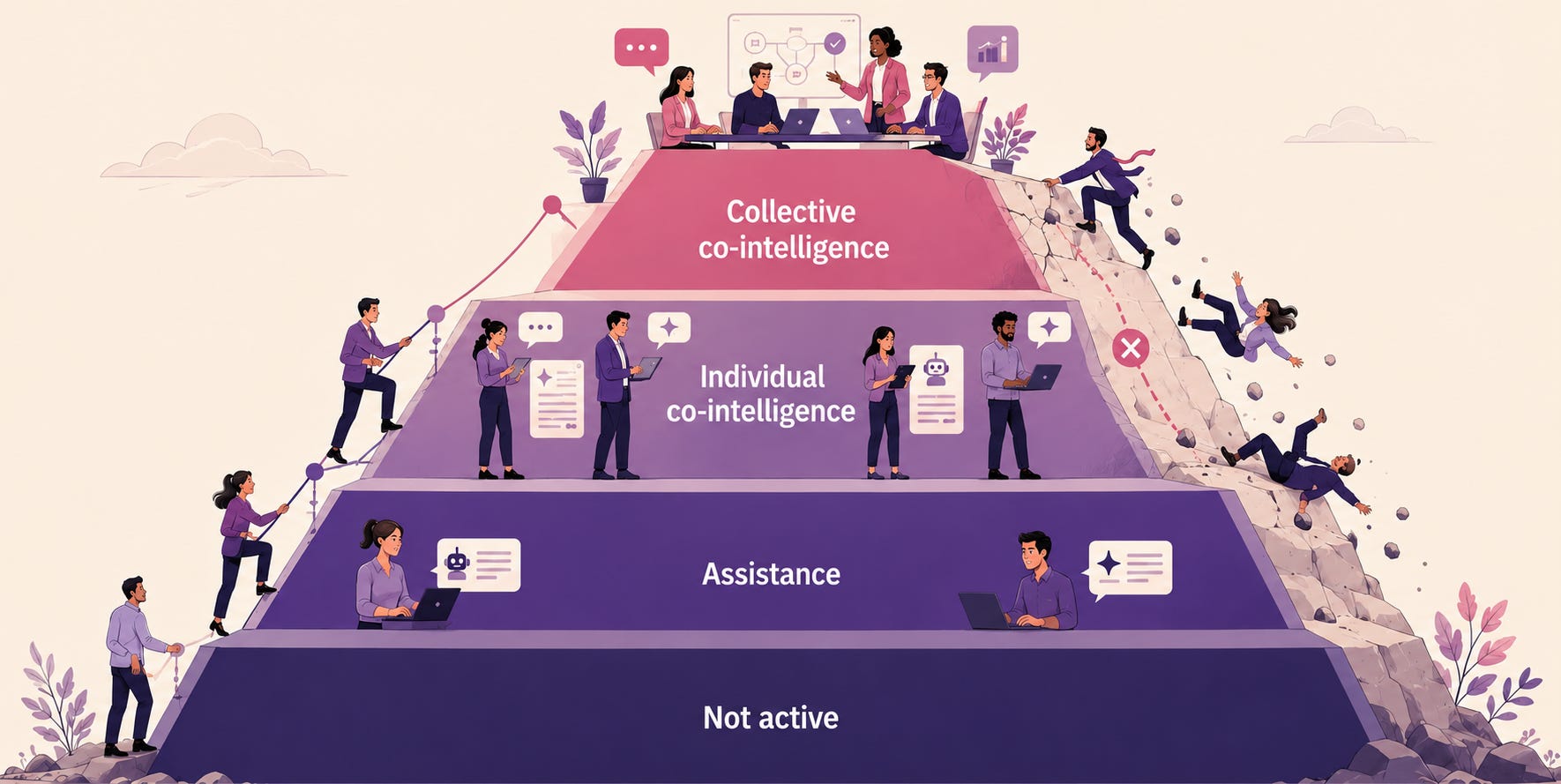
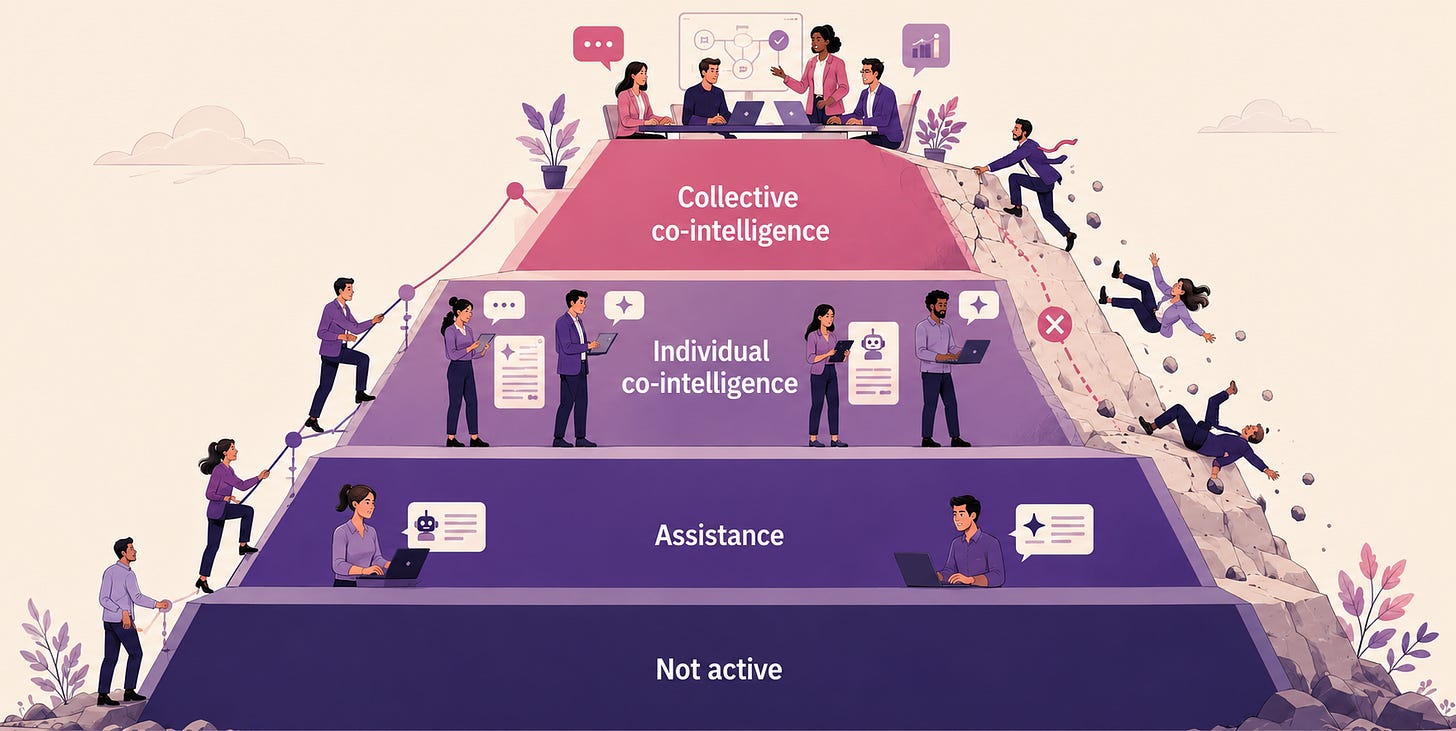
The model behind the Pulse views AI readiness as a progression: from not using AI, to assistance, to individual co-intelligence, and eventually to collective co-intelligence. The climb looks simple on paper. In practice, the human part may be where things start to slow down.
The data set is still small and does not yet reveal clear trends or validate firm conclusions. But after discussing the results with the first users, one pattern is worth exploring: even curious AI users are starting to hit human limits.
The issue is no longer only whether people adopt AI. It is whether they can build the habits, judgment, patience, and shared ways of working needed to use AI well. Five early signals point in that direction.
1. Low turnout is also a signal
It seems hard to get people to pause and examine what AI may actually be doing to their jobs. That may itself be an early signal. Possible reasons include AI overload, data privacy concerns, and being too busy with day-to-day work.
Some may also prefer to avoid the topic altogether. There is a difference between being interested in AI in general and asking what it may mean for your job, your value, and your future.
That tension is interesting because organizations are increasingly focused on redesigning jobs, breaking roles into tasks, and automating workflows.
2. The curious are already moving fast
Given the low turnout, it is probably not surprising that the first May users were not AI beginners. Most were already confidently using AI as a thinking partner, at a level we call individual co-intelligence. They use AI in new and sophisticated ways to achieve goals neither they nor AI could have reached alone.
The May users also seemed to understand that AI readiness goes beyond technical AI literacy. Without human components such as focus, judgment, confidence, responsibility, learning habits, and the ability to work well with others, it becomes harder to sustain an early advantage.
3. Speed arrives before structure
In this first Pulse group, the lowest overall score was for recovery and reflection: the ability to pause, integrate, and stay grounded when AI speeds up work.
Even advanced AI users still lack habits and routines around when to use it, when not to use AI, how to check the output, how to keep learning, how to avoid dependence, and how to close the loop. The constant release of new model versions and tools does not make it easier.
AI use is happening, but the human operating system around it is still catching up.
4. Individual speed creates a collective bottleneck
The jump from individual to collective co-intelligence (our highest level) is complex. Individual AI use does not automatically become collective AI maturity. We believe this is one of the main reasons organizations, despite huge investments, are not yet seeing tangible results.
Most work depends on colleagues, managers, clients, experts, approval loops, trust, timing, shared context, and the daily human machinery. A company does not reach Level 3 just because a few smart people use ChatGPT, Claude, or Copilot well. It reaches that level when AI use becomes visible, discussable, trusted, and integrated into overhauled workflows.
Without that, AI creates uneven speed. Some use AI to prepare better. Others use it to avoid thinking or avoid people. Some produce polished work faster than the system can absorb it. Others start feeling judged, bypassed, or left behind.
A recent Harvard Business Review article makes a similar point from the manager’s perspective. As AI accelerates individual execution, managers are becoming the bottleneck: they have to review more output, give faster feedback, and make quicker calls than traditional management rhythms were built for.
5. Patience with others is a warning signal
The weakest social signal was low patience with people who move more slowly with AI. That matters because it confirms the bottleneck effect and points to a future challenge: readiness gaps are not just technical gaps. They can become social gaps.
If people who move fast with AI lose patience with those who move more slowly, AI readiness becomes a social problem, not just a skills problem. The faster users may start seeing others as blockers and disconnect. The slower users may become defensive or quiet. Leaders may reward visible AI speed without noticing whether it actually improves collaboration, trust, or decision quality.
And then organizations get exactly what nobody asked for: more output, more friction, and more meetings about why productivity is not improving.
Our takeaways
These early signals support our working hypothesis: AI readiness is not just technical literacy, but also our ability to stay sharp, connected, and aligned as AI changes how work gets done.
In particular, the move from individual AI use to collective maturity will depend on whether people can stay curious and empathetic when AI creates different paces, habits, and levels of confidence within the same team.
Yuval Noah Harari, author of Nexus, Homo Deus, and Sapiens, recently described AI as one of the largest psychological and social experiments in human history. That feels closer to the real issue at work.
You may already recognize some of this in your own work. Maybe AI helps you produce more, but you are not sure whether you are learning more. Maybe you use it often, but without a clear rhythm. Maybe you feel ahead of some colleagues, behind others, or unsure how transparent to be about your use of AI.
That is what the free Futurebraining AI Work Readiness Pulse is designed to help you notice. It gives you a first snapshot of how AI is affecting your work, where your human capabilities may be under pressure, and what you may need to strengthen next.
If you would also like to receive your full Diagnostic report as part of this early pilot, email us at info@futurebraining.com with “Full Diagnostic” in the subject line, and we will follow up.