%20(2).png?width=300&height=100&name=fb%20logo(300%20x%20100%20px)%20(2).png)

co-intelligence
futurebraining
AI fluency


Why do I feel so depleted lately? I wondered whether it was just spring fatigue, a bit of age, or bad sleep.
Over the last few weeks, I have moved from talking to building things with AI tools. Generating code, patching bugs, wiring endpoints, testing, and trying to keep the whole thing coherent and safe. It feels like a superpower, but it comes with a price. As Puneet Chadok says in a CNN interview, AI is a full-contact body sport, and I feel pretty beat.
I am relieved to report that this is not just a personal feeling, but is starting to show up everywhere.
The reality is more mechanical. The human brain is not an infinitely expandable cloud service. It is a living system with limits—attention, working memory, executive control, energy, judgment. AI does not expand those limits; it amplifies output while leaving the rest of the system to absorb the pressure.
You feel it as fatigue, confusion, decision drag, shallow thinking, brainfog, and the strange sensation that you are busy all day without really getting anything done.
A big part of that pressure comes from what you’re actually doing now: supervising the machine.
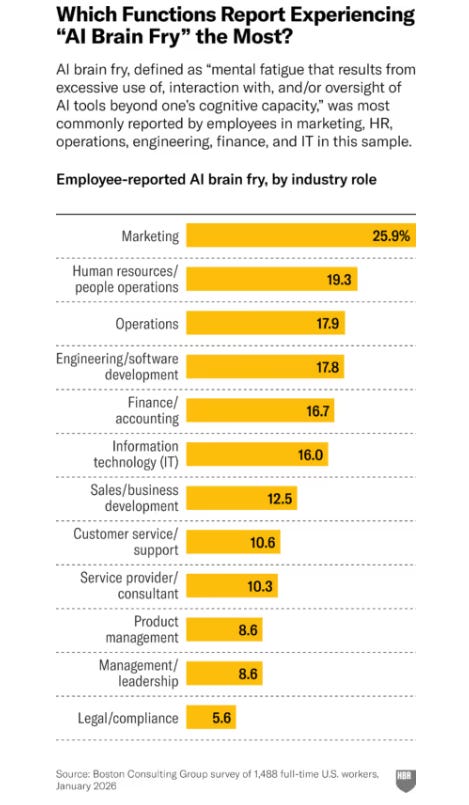
In one large study of nearly 1,500 workers across industries, roles, and levels, those performing high levels of AI oversight expended 14% more mental effort, experienced 12% more mental fatigue, and reported 19% higher information overload.
The same study shows that productivity rises when you move from one tool to two, rises again with three, and then drops once you go beyond that.
So yes, the machine is fast, but your brain is stuck doing quality control at high speed.
That comes with a cost. Workers experiencing what researchers now call “AI brain fry” – mental fatigue that results from excessive use of, interaction with, and/or oversight of AI tools beyond one’s cognitive capacity – report:
At the system level, the same pattern is already visible. Companies report 10x increases in AI-generated code, with massive backlogs of work that no one can properly review. AI is shifting the bottleneck from production to supervision. And we are the bottleneck. These are business costs.
The interaction still feels light, but the “cognitive responsibility” is not.
Another study shows the same pattern: AI does not reduce work. It expands it. People work faster, take on more, and end up working longer.
Recovery is not a luxury add-on to cognitive work; it should be a part of our operating system.
If experienced coders, systems thinkers, and other ITC professionals are already feeling strain, the rest of us (most of the workforce) are not just feeling it; we are compensating for it. Technical experts carry mental blueprints to filter noise, discard nonsense, and deal with complexity. When AI produces ten plausible options, they know which two matter.
Without that structure, everything looks reasonable. Everything needs checking. Every answer spawns three more paths.
This is how it shows up for me:
This “panic loop” comes with a price: You hit usage limits, and your first instinct is not to stop, but to pay more to keep going. The system is pulling you forward faster than your understanding and wallet can keep up.
As you start to make progress, confidence pulls you into areas that look simple at first but are costly up close. In our example, you just keep flying higher.
Designers start coding. Coaches start building apps. Founders start managing infrastructure. People jump into technical water because the entry point feels easy, then discover they are not strong swimmers. Who comes to the rescue?
At some point, you realize you can no longer explain your own project clearly to a colleague or partner. You know it works, more or less. You know roughly what the latest version does. But the logic underneath has become foggy.
You are now a lonely passenger in your own system, quietly losing trust and companionship as you go.
Your cognitive energy is not limitless. At some point, you stop paying full attention. And that is when it gets dangerous, as AI will continue to give you confident-sounding solutions, but you are simply too tired to double-check.
A few simple disciplines already make a major difference when you are transitioning into more co-intelligence work with AI and want to keep your brain sharp, indepedent and connected to other humans
Before opening a chat, write a simple specification—and keep it updated as you go. This makes handovers to new chats, threads, or tasks much easier.
Then document changes:
This combined view acts as a control surface. It reduces drift, cuts down panic loops, and gives the AI something firmer to start and continue with.
Remember, if you cannot explain what changed and why, you are already losing control and the people around you.
You do not need to become an engineer overnight. But if you are generating code, learn some code, and if you are working with APIs, databases, security, or deployments, learn the basics of those too.
Every bit of real understanding builds a mental structure that can support the extra load.
Leave space between prompts. Batch work into phases (if AI does it, you can too). Close extra tools. Resist the urge to do “one more quick check” every time the system gives you a dopamine pellet.
Your brain needs recovery, not after the work, but during it.
In the same research, workers whose managers actively helped them think through AI usage reported 15% lower mental fatigue. Those left to “figure it out themselves” showed higher fatigue.
So find a colleague, a partner, a small group, even an informal “thinking buddy” who can challenge, sanity-check, and help you explain what you are doing.
Because the moment you can no longer explain your own system to another human, you are not just tired, you are losing control.
So when you feel flattened at the end of the day, do not be too quick to call it spring tiredness. It is just your brain trying to cope with new levels of pressure without the reinforcements in place.
That is the real challenge of AI: work better and faster, without getting dumber, depleted, and disconnected.